
The Convertible was also known as the 5140 and was first sold in April 1986. This was a world in which portable computing was in it's infancy and whilst Data General's /One and GRiD's Compasss had established flat displays, folding clamshell onto a machine which would sit on your lap, IBM was many many years away from this and still struggling to design something portable which would appeal.
It was replaced in 1991 by the PS/2 L40SX and even more so by the often overlooked PS/55 Note in Japan.
Here's a brochure!

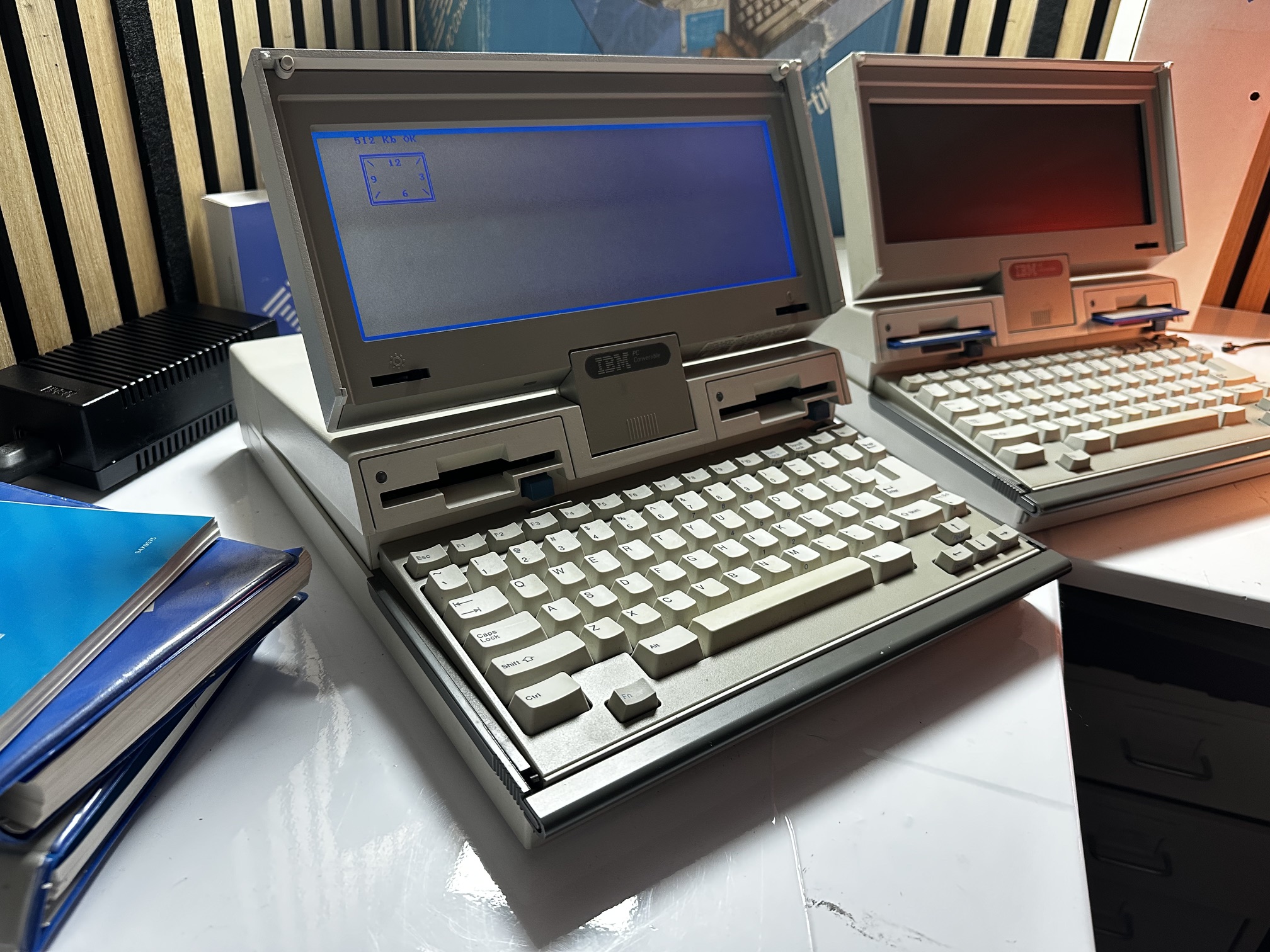
The Convertible came in three models, largely spotted by their differing displays. The first one with a bloody awful non-backlit panel you could hardly read. The second one had a supertwist panel you would hardly read. The first was an EL display with backlight you could read. The display is wide and vertically compressed and is CGA compatible. You could also attach a normal monitor.
The most obvious way to tell the 3 screens apart is that the first one only had one slider, the last had 2.
Expansion modules were the name of the game, turning a slightly long machine into something crazy-long. You could bolt onto the back various plastic modules to add modems, printers, video, serial, parallel adaptors, a voice synethesiser (!) and so on. It was a bit of a tough ask that IBM was making you add these plastic modules on just to then be able to do something most (portable) PCs would just do.
The year this machine was released was an utterly mad point in IBM's PC division. Some of the 'upgrades' for this machine are shared with the godawful PCjnr and whoever came up with adding plastic panels on the side of the Jnr applied the same concept to the Convertible.
Pushing under the IBM logo in the centre of the panel releases the screen!
Here is a gallery of a couple of my machines. One has the original god-awful display which can hardly ever be read and is degrading year-by-year from the bottom. The other has the (by comparison) fabulous Electro-Luminescent blue display which works a treat and does not seem to be degrading whatsoever!
I've always fancied adding on the green screen display but they're always far too expensive.
CRD on youtube did an absolutely fantastic video on the convertible here.


One of these machines had both Floppy drives not recognising any disks, so I decided to inspect the floppy drives...
When you prise up the keyboard, you see the slightly unusual memory configuration inside the machine. This is SRAM which, unlike DRAM, doesn't constantly need to be refreshed with the same data to function.

This aligns closely with the Convertible's 'always on' state, where the CPU will just stop in a sort of 'paused' state, waiting to start up and carry on. The SRAM, whilst getting some form of constant power from the built-in battery, will retain the working data and resume operation. This SRAM configuration above aligns closely with the standard 'upgraded' configuration of the machine with it's 4 x 128Kb SRAM expansion modules, connected to one another.
This SRAM configuration is kinda similar to the PCradio, which also has built-in SRAM to go with it's 'always on' nature.
Once you're removed the keyboard, 2 screws on each floppy drive will allow them to slide right out:

Taking a closer look at the floppies, each drive had the earlier-type of Toshiba drives, which had the drive mechanism sandwiched between two PCBs. The L-shaped board had 3 electrolytic througholes, which had not failed but I replaced them anyway. Notice when you remove them, the capacitor labelling silkscreened onto the PCB has a small + symbol denoting the + side of the capacitor, but also unhelpfully the yellow circle around the cap has a filled yellow segment which to my eye denotes where the negative pin goes. Ignore that. The negative is the oppposite pin to where the circle has a yellow filled section....here's a close up with the caps removed...

Here are two annotated images showing the values of the 8 capacitors. All 5 of the surface-mounted caps on the second PCB had failed and I replaced them with ceramics, which didn't seem to be a problem. Both drives came back to life and would read disks normally.


Interestingly the other PC Convertible I owned had different Toshiba drives, of which I took the picture below:

These drives didn't have surface-mounted capacitors and were working perfectly. Sometimes you have to make a 'if it ain't broke' call, as to whether you're going to risk more problems by replacing a bunch of capacitors which haven't failed - the risks on a floppy drive mainly being knocking something out of alignment. So I didn't.